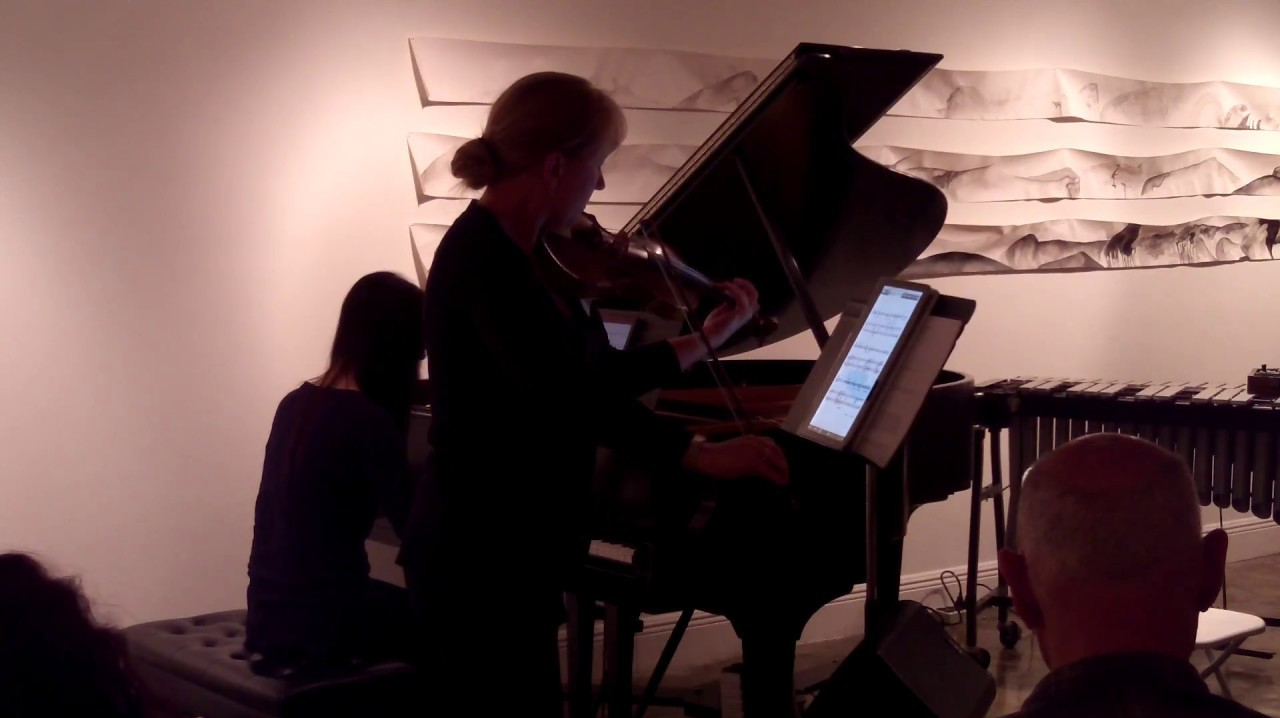
Photo and video, courtesy of YouTube (tumeplais) _
Arabs conquered Iran (then Persia) in 636 AD when the kings of the Sassanian dynasty were in power for over four centuries.
When they seized the palace of the Sassanian king in their capital in Ctesiphon (تیسفون), or current Baghdad (بغداد ), they discovered an enormous carpet in the throne room.*
The carpet was called “The Springtime of King Khosroes.”44 This enormous carpet was approximately 30 metres x 150 metres.*
Historians report that this monumental carpet depicted a series of garden beds framed by watercourses, with the trees and flowers picked out in gold and silver threads, the gravel paths studded with seed pearls, the border shrubs bejewelled with precious stones, and the streams sparkling with blue gems.*
The Arabs cut this 4,500 m2 carpet into small pieces as war booty.44
This carpet inspired many throughout the centuries, among them and the latest was the American composer Morton Feldman (1926-1987) who composed ‘Springs of Chosroes’ for piano and violin in 1977.*

You may listen to this 15 minutes piece on YouTube.
Iranian carpets and power
Carpets were always associated with power and prestige in the royal courts of Iran and generally throughout the region: from Neo-Assyrian’s (نو آشوری ها) in 900 BC to Achamanian (هخامنشیان) palaces in 400’s-600’s BC, and Ashkanian/Parthian dynasty (247 BC-224 AD) to Sassanian (ساسانیان) kings until 600’s AD, and later in the courts of the Muslim rulers, the Abbasian (عباسیان).*
The historian Plutarch (46-119 AD) also occasionally mentions the gardens that look like carpets.55
These gardens were presumably patterned after the Mesopotamia carpets that were eagerly sought by the Greeks and Romans. At the time when these references are made Mesopotamia region was ruled under the Persian dynasty of Parthian اشکانیان (247BC to 244 AD),* and their capital was Ctesiphon ( current Baghdad).
It is said that Nero, the fifth Roman emperor, 54-68 AD, paid 4 million sesterces for a single carpet.56 To get a sense of the value of 4 million Roman sesterces, at the time a soldier’s annual salary was about 900 sesterces, and a Roman senator (under Augustus) had to own property equal to 1 million sesterces.
The manifestation of power in Sassanian Persian courts inspired the newcomers to Throne; the early Muslims (the Abbasian dynasty عباسیان).*
The new Muslim rulers followed the same tradition in designing similar gardens.
They installed a gold and silver tree in the palace garden of their new capital Baghdad, which was the same capital of the Sassanian kings.*
On the trees’ branches of the garden, gold and silver birds sang when the wind stirred them.45
The tradition of using sumptuous carpets before the king was later brought from Persia to Spain in the 10th century.*
Persian traders brought Safavid carpets that were high in demand in the European market in the Safavid era (1501-1736).*
Shah ‘Abbas I embassy for trade received at Duke’s palace in Venice, painting by Carlo Caliari, 1595 (Source: wikimedia.org)

Carpets continued their popularity among the Kings and their power circles as well as among the ordinary people.
Antoine Galland, who lived in Istanbul, 1670, notes that during holiday celebrations, the shops of Gaiata and the Old City remained open into the evening, “spilling out into the street, their sofas covered in the most beautiful Persian carpets and cushions.
Among many famous Safavid carpets is the Ardebil Carpet that was commissioned by Shah Esmaiil, of Safavian dynasty (1501-1736), for his ancestor’s shrine in the city of Ardebil in Iran.
The shrine of Shaikh Safi Addin Ardebili, city of Ardebil, Iran (courtesy of R. Khanbabaei)

The Victoria & Albert Museum in London, where the Ardebil Carpet is currently displayed remarks the carpet as ‘ a remarkable piece of beauty of design and execution.’

The Ardebil Carpet, Victoria & Albert Museum, London

Share the story
A piano and violin concerto for a Persian carpet; carpets and power
Tweet
Sentences showing an asterisk (*) above may be traced to the provided research materials containing close to 70 Parsian and English academic references.
- The Hanging Gardens of Nineveh, Author(s): Karen Polinger Foster, Source: Iraq , 2004, Vol. 66, Nineveh. Papers of the 49th Rencontre Assyriologique, Internationale, Part One (2004), pp. 207-220
Published by: British Institute for the Study of Iraq - Victorian & Albert Museum archive
- Ziegler’s Sultanabad Carpet Enterprise, Author(s): Annette Ittig, Source: Iranian Studies , 1992, Vol. 25, No. 1/2,
 Persia; Past & Present