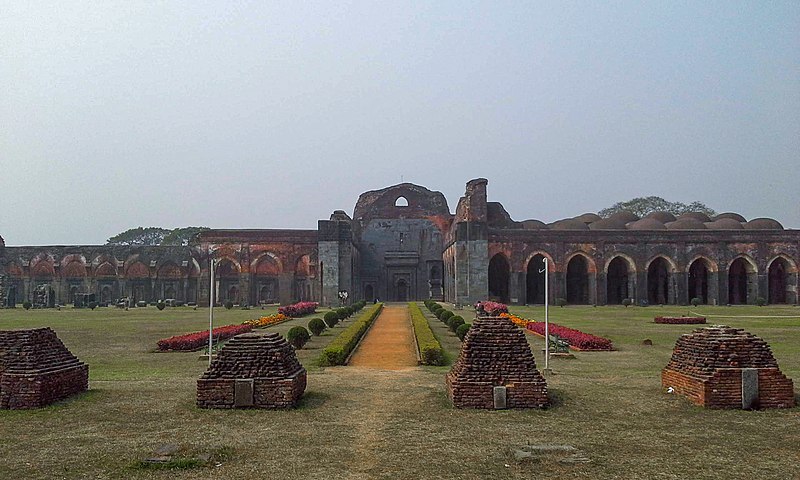
(photo: The largest Indian Mosque, West Bengal, 1300s)
Persian influence in Bengal in the 18th and 19th Century
(This piece is a part of series about Rabindranath Tagor’s life and upbringing in Hafez-centric Bengal)
Bengal had a population of approximately 50 million at the time.
It is well known that the Persianate civilization and the international appeal of its Persian literature were widespread in Bengal for many centuries before Rabindranath Tagore (Nobel Prize winner ,1913).
What is less known is that the Persianate civilization that covered a vast area from Ottoman Turkey to Persia, from the lands of Central Asia to most of Mughal India had also been ‘Hafiz-centric’ for five centuries before Tagore. ”143
During Tagore’s childhood, the men and women of learning in Bengal were obsessed with spiritual issues. Spirituality and metaphysical debates permeated the literary culture of nineteenth- and early twentieth-century Calcutta.20
This was also the case in Bengal from mid 19th century to mid 20th century. As we see in the writings of Tagore’s father and his teacher Roy, both were infatuated with ‘Hafiz-centric’ poetry in their conversation, their compositions, and devotional meditations.
Tagore was raised not as a Hindu, but as a member of Roy’s Brahmo Samaj reform which had been influenced by Sufism. That explains why Tagore rose above the sectarian divisions.
In some of Tagore’s short stories, Muslims figures are the lead characters in a favourable light.40 Islam is represented in many of his prose writings.
One scholar has described Bengali literature as “une literature en langue bengalie d’inspiration persane ”48 or ادبیات بنگالی زبان باالهام’ از فارسی’
Persian newspapers (17th century Bengal)
The widespread of the Persian language led to the first Persian-language newspapers soon after the printing industry arrived in India in the 17th century.
Persian-language publications in India were:
مرآتالاخبار (Merat al-Akhbar),
آموزگار شفیق (Amoozgar Shafiq), which had Persian-language editions,
حبل المتین (Habal al-Matin), (1272–1309),
شمس الاخبار (Shams al-Akhbar),
سید الاخبار (Sayyid al-Akhbar),
کوکب ناصری (Kokab Naseri),
دلگشا القلوب (Delgsha al-Qulub),
اخبار ایرانی (Akhbar e Irani),
روزنامه هندوستانی (Rooz Nameh Hindustani), and
جام جهاننما (Jam e Jahan Nama).
The newspaper اخبار (Akhbar) had been published in Persian in New Delhi since 1789.
One of the first English-language newspapers published in Calcutta was The Bengal Hurkaru (1795). The word hurkaru, or hircarrah, as it was spelled in the beginning, is a Bengali derivative of the Persian word harkara (هرکاره messenger). (source: world digital library)
The most important Persian newspaper that became popular in India was the weekly (مرآتالاخبار) that Ram Mouhan Roy, the Indian reformer, founded and published in Bengal.7
Roy was forced to stop publishing it sixteen months later in 1823 due to British censorship*. The final issue of Merat al-Akhbar featured two verses by Ḥāfiẓ.8

Persian Language and Culture in Bengal Goes Back to 1200s
“Without proper knowledge of Persian,” one scholar pointed out, “it is difficult to go through the history and to understand the culture of Bangladesh. One has to learn Persian if one wants to know the past glory and grandeur of Bangladesh.”43
Persian became the official language of state when the ruler Muhammad Khalji entered Bengal in 1206 *.44
For the following 150 years, Persian culture continued to permeate the country.
The golden age of Persian literature in Bengal started with the reign of Ghiyāth al-Dīn A‘zām Shāh (غیاث الدین اعظم شاه) in 1389–1400. Hafez lived in Iran (then Persia) around the same time.
Hafiz enjoyed popularity in Bengal even in his lifetime.
Persianate literary forms and styles, as well as Islamic-Iranian sufism, permeated Bengali philosophical, theological, and literary writings.
Sayyid Ashraf Jahāngīr Simnānī d.1405 (میر سید اشرف جهاهگیر سمنانی), an important Sufi author who flourished around the time of Ḥāfiẓ (1315-1390), noted that there was no town or village in Bengal where Sufi saints had not settled*.46
Since Persian was Bengal’s main literary language for centuries before Tagore, Bengal was regarded as “the easternmost haven of Indo-Iranian culture on the Indian subcontinent.”42
For another 150 years, Persian continued to be the official language of Bengal during the Husayn Shah (سلطان حسین) period in 1494–1538*, 45
With Akbar Shah (اکبر شاه) conquest of Bengal in 1576, Persian further remained as the “the language of the educated classes, dominating the literary and cultural life” of the land.*52
This permeation continued through Gurkhanian Empire of India (گورکانیان)which was a Muslim dynasty with Iranian culture that ruled the Indian subcontinent (1526–1858).*
Persian remained the official language of Bengal until 1837, when replaced by English*,53
However, its elevated status and mainstream currency could not be eradicated immediately.
Even a century after the British stopped Persian publications, spoken Bengali contained substantial Persian elements,*67
knowledge of Persian continued to be essential to secure good employment even in early 19th century Bengal.
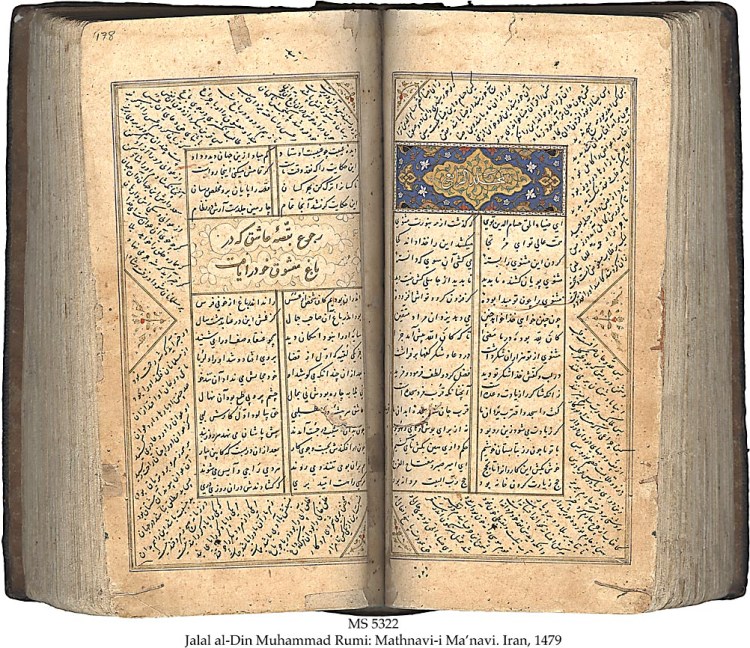
A 1479 hand-written copy of the MATHNAVI of Rumi (the Iranian sufi poet)– Shiraz
In this series we will know more about the Rabindranath Tagore family, get familiar with his pedagogy, and the widespread Persian culture of Bengal before the division into East and West Pakistan, and the role of Persian Islam in the Indian reform of Brahmo Samja.
Persian; The Language Of Bengal Until 19 Century Before Replaced by English
Tweet
- Hafez and Rabindranath Tagore
- Persian; the language of Bengal until British arrvide in 19th century
- Persian sufism and Indian reform; Ram Mouhan Roy (1772-1833)
- Imam Ali’s followers in a princely family; Rabindranath Tagore
- From avoiding schools to winning the literary Nobel prize
- Calcutta (19th century); the rendevous of Persian poets
- Rabindranath Tagore’s trip to Shiraz to visit Hafez (1932)
- Why did Tagore renounced his Knighthood
- Hungry Stones; an excerpt of a short story by Rabindranath Tagore
- Shiraz 1932; Tagore meditating beside the tomb of Hafez
- Hafez And His Advice For Rabindranath Tagore
- Persian; The Official Language Of The 19th Century Bengal Before English
- From Persian Sufism To The Indian Reform; Ram Mouhan Roy (1772-1833)
- Rabindranath Tagore And His Princely Family
- From Avoiding Schools To Winning The Literary Nobel Prize
- Calcutta (19th Century); The Rendevous Of Persian Poets
- Rabindranath Tagore’s Trip To Iran; Shiraz, 1932
- The 1919 Massacre in باغ جیلان والا (Jillan Walla Bagh) And Knighthood Renouncement
- Hungry Stones; An Excerpt Of A Short Story By Rabindranath Tagore
Suggested readings and references:
Special thanks to Dr Leonard Lewisohn from the University of Exeter for his research that contributed to the main body of this series adaptation. Additional materials were sourced from Professor Emeritus Irfan Habib’s, and Dr Beatrice Teissier’s publications. Sentences showing an asterisk (*) above may be traced to the provided research materials containing over 145 Parsian and English academic references.
- Rabindranath Tagore’s Syncretistic Philosophy and the Persian Sufi Tradition, Leonard Lewisohn, University of Exeter, 2017, Published by Penn State University Press
- TEXTS FROM THE PERSIAN IN LATE EIGHTEENTH-CENTURY INDIA AND BRITAIN: CULTURE OR CONSTRUCT? Beatrice Teissier, Oriental Institute, Oxford, 2009, Published by Taylor & Francis, Ltd.
- Jallianwala Bagh Massacre, Irfan Habib, 2019, Published by Social Scientist
 Persia; Past & Present