FIRM ALLIANCE: SHAH AND EMPRESS OF IRAN, APRIL 1962: 11-13, J. F. Kennedy Library
Document 1: National Security Council, NSC 26 report, “Removal and Demolition of Oil Facilities, Equipment and Supplies in the Middle East,” August 19, 1948, Top Secret
Date: Aug 19, 1948
Description
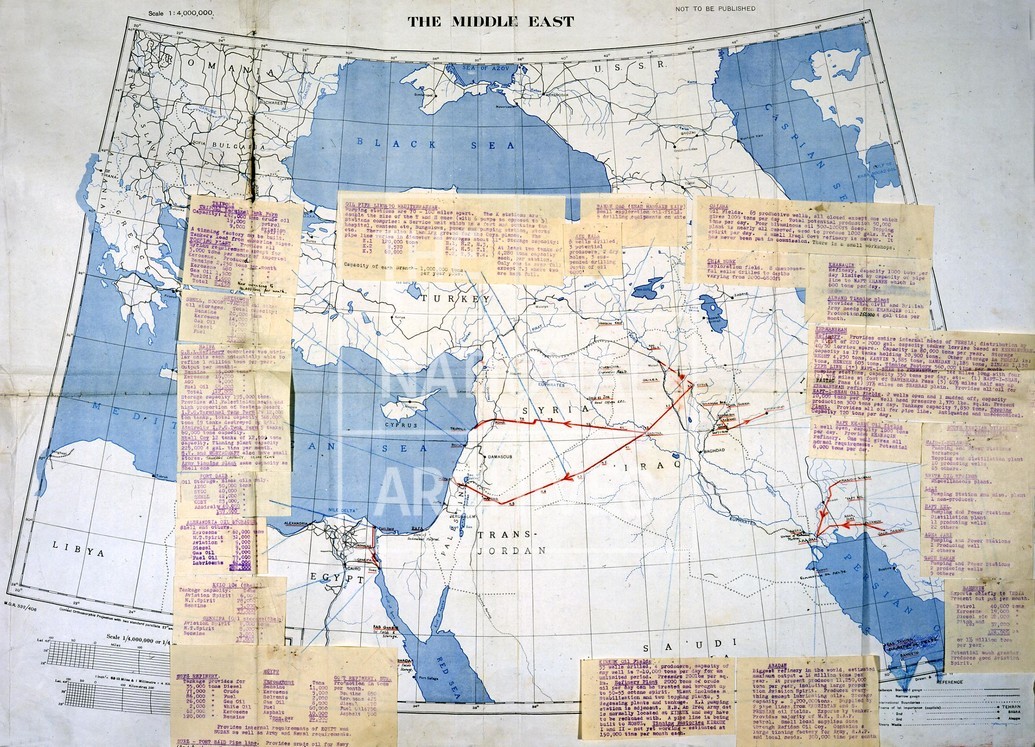
This report set the stage for the denial policy during what the CIA called an “atmosphere of emergency.” The Berlin Blockade crisis was two months old and a Soviet thrust into the Middle East seemed possible. The Joint Chiefs of Staff believed it unlikely the United States and its allies could stop the invasion, but a stop-gap measure could stall the Soviet military by denying it Middle East petroleum.
NSC 26 was a collaboration of the CIA, NSC, State Department and SANACC, also known as the State-Army-Navy-Air force Coordinating Committee. Most of the report’s recommendations found their way into the denial policy that landed on President Truman’s desk for approval in early 1949. American and British oil companies would provide the manpower and expertise to plan and execute the denial policy. Training company employees and stockpiling supplies including explosives in advance would ensure denial plans were ready to execute.
NSC 26 also singled out the issue that bedeviled the denial policy. Destroying a friendly country’s main industry could produce “unfavorable political and economic consequences” against the United States. This report grapples with what to tell Saudi Arabia, which at this stage was the only country the United States expected to be responsible for in the denial policy. It was of the “greatest importance” to tell King Ibn Saud of Saudi Arabia or his government about the abandonment and demolition program to minimize these negative consequences. The U.S. secretary of state would disclose the denial policy’s existence at his discretion. But Saudi Arabia wasn’t told because of an expected negative reaction, and the State Department again in 1952 refused to disclose the denial policy because it could interfere with planned negotiations to form a military pact in the Middle East. In 1956, the State Department claimed conditions were still not right to tell Saudi Arabia.
Britain, which had responsibility for the policy elsewhere in the Middle East, also didn’t want to disclose the denial policy to host governments. But fears of a security leak haunted the denial policy. Anglo-Iranian Oil, later renamed British Petroleum, believed it would be subject to economic blackmail or worse if Iran’s government learned of the policy. Aramco, the Arabian American Oil Company, jointly owned by a number of American oil concerns, eventually believed that not consulting Saudi Arabia about the denial policy risked the company’s economic survival.
Source: Truman Presidential Library, President’s Secretary’s Files, Box 117

Document 2: National Security Council, (NSC 26/2) report, “Removal and Demolition of Oil Facilities, Equipment and Supplies in the Middle East,” December 30, 1948, Top Secret, with cover note for the President, January 6, 1949
Date: Jan 6, 1949
Description
President Harry Truman approved the Middle East denial policy on January 10, 1949. NSC 26/2 called for high-level conversations with Britain, a crucial step since Britain was the governing authority in Kuwait, Qatar and Bahrain, and British companies controlled Iran and Iraq’s oil industries. The military would help with U.S. denial plans when possible. In fact, a Marine task force was initially assigned, but it was pulled in 1950. Britain believed some troops were necessary to at least assist British oil companies in executing denial plans. But NSC 26/2 was basically conceived as a covert civilian operation. The State Department provided overall supervision and had already brought in the CIA to work with Aramco on the denial plan for Saudi Arabia. Aramco, owned by predecessor companies of Exxon, Chevron, Mobil and Texaco, controlled Saudi Arabia’s oil industry.
Much of this planning was about destroying or disabling oil facilities and equipment, but policymakers and oil companies struggled with how to best keep the Soviets from tapping Middle East oil wells. They initially thought plugging oil wells with cement would take one to two months, far longer than a Soviet attack would likely allow. NSC 26/2 ordered a study of radiological weapons, which would spread radioactivity without destroying the wells, to keep the Soviets out of the oil fields. The CIA later rejected their use since the Soviets would probably send Arabs deemed “expendable” to keep the wells flowing. Tweaking the ways to plug wells with cement eventually slashed the time to one to two weeks.
Source: Truman Presidential Library, President’s Secretary’s Files, Box 118
Document 3A: British Embassy, Memorandum summarizing discussions with U.S. officials on April 30 and May 1, 1951, in Washington, D.C., with attachment about oil-denial priority target list, Top Secret
Date: May 1, 1951
Description
The approval of NSC 26/2 ignited efforts in 1949 to build denial plans, with the United States responsible for Saudi Arabia, and Britain for Iran and Iraq. These plans were refined in 1950, but by early 1951 the denial policy was in trouble. British officials had cancelled a meeting with the United States about the policy, a move ostensibly made to allow time for a study about defending the Middle East against a Soviet attack. But it was Anglo-Iranian Oil, worried about a security leak to Iran’s government, that wanted Britain out of the denial policy. An angry George McGhee, a U.S. assistant secretary of state, told a British Ministry of Fuel and Power official it was time for his government to make up its mind regardless of what Anglo-Iranian Oil thought. Britain relented and a few weeks later rejoined the denial policy.
Source: British National Archives (Kew), POWE 33/1899
Document 3B: British Foreign Office, Memorandum, “Oil Denial: Record of Meeting Held in the State Department on 1st May 1951
Date:May 1, 1951
Description
Available British documents include a summary of meetings and briefings with the United States on April 30 and May 1 in Washington, D.C. They show the British reaffirming their responsibility for denial plans in Iran and Iraq while the United States remained responsible for Saudi Arabia. In a concession, Britain tentatively agreed to the CIA developing denial plans for Kuwait, Qatar and Bahrain where a mix of American and British oil companies operated. But Britain, the governing authority in the three countries, would be responsible for ordering the plans executed in Kuwait and Qatar. Things were more complicated in Bahrain where two American oil companies controlled its oil industry. A decision was deferred about which country would trigger the denial plan for Bahrain although the summary shows Britain willing to give it to the United States.
American and British officials generally agreed on denial targets with refineries and petroleum stockpiles given top priority. The attached British priority target list is from “Project Neckpiece,” an early British denial plan hatched soon after NSC 26/2 was approved. But the British remained skeptical about plugging oil wells in Iran and Iraq. Both countries would be on the front line of a Soviet invasion which meant even less time to seal the wells. A suggestion by U.S. officials to ask Iran and Iraq to help with the well plugging was quickly rejected by the British. This suggestion reflected the view of some involved in the denial policy that Middle East governments might support well plugging since it would preserve their oil by preventing the Soviets from setting the wells on fire if forced to retreat. But reluctance to reveal any part of the denial policy remained a stumbling block.
Source: British National Archives (Kew), POWE 33/1899
Document 4: Minutes of briefing by CIA to British Embassy and military officials at U.S. State Department, May 1, 1951, Top Secret
Date: May 1, 1951
Description
This CIA briefing played a key role in persuading the British to allow the intelligence agency to develop denial plans for Kuwait, Bahrain and Qatar. The briefing at the State Department, which occurred during two days of talks in Washington, featured CIA operative George Prussing, according to British minutes of the briefing. A British embassy official and military officer represented Britain. Prussing had been a safety director for Union Oil in California before World War II and worked with the federal Petroleum Administration during the war to protect West Coast refineries from sabotage. He went on to become a consultant to the Office of Policy Coordination, an agency later folded into the CIA, which was involved in sabotage missions in foreign countries. He became a full-time CIA employee in 1950.
This dog-eared document is missing some words, but it reveals for the first time the scale and several details of the denial plan for Saudi Arabia. It relied on 45 senior Aramco managers and another 600 company employees. (The 200 employees figure in the document was later clarified to mean for each of Aramco’s three administrative districts in Saudi Arabia.) The number of employees involved was deemed sufficient to allow for successful execution of the denial plan even if some employees were absent. And to avoid a security leak of the denial plan, most Aramco employees were told only the part they would execute. The CIA also inserted five undercover operatives into Aramco jobs ranging from a storekeeper to assistant to the general manager. They would brief the intelligence agency about any developments affecting the denial plan.
The plan would unfold in three phases and deny Saudi Arabia’s petroleum to the Soviets for six months to a year. Prussing also provided an example of selective demolitions, a key feature of the Aramco plan to allow quick resumption of production after the Soviets were ousted. Alternators would be disabled by destroying their couplings and governors which controlled the flow of electricity. It was assumed the Soviets couldn’t replace these parts.
The CIA had imported military-grade explosives for the demolitions, but flame throwers would also be used to destroy supplies and small machinery. Thermite grenades, which produced high temperatures, would destroy oil stockpiles, vehicles, spare parts and tires. Prussing also discussed using “Oatis” plugs. He was probably referring to the Otis plug which was invented in the 1930s by Herbert Otis. After being inserted in an oil well, it could be opened or closed with a special tool. That promised a quicker method to seal the wells, but it was later dropped from consideration without explanation.
Prussing and a U.S. military official at the briefing also expressed their disappointment with British denial plans for Iran and Iraq because British oil companies weren’t involved. But they would soon conclude British officials had misled them.
Source: National Archives (Kew) POWE 33/1899
Document 5A: Telegram from British Joint Staff Mission to Ministry of Defence, London, May 2, 1951, Top Secret Cypher Telegram
Date: May 2, 1951
Description
The impact of a CIA briefing on May 1 quickly rippled to Britain’s Ministry of Defence in London in a pair of telegrams the following day (including this one) sent by the British Joint Staff Mission in Washington, a military group created during World War II to forge cooperation with the United States. The ministry was convinced troops were necessary to some degree for denial plans to succeed. At minimum, the British Army’s Royal Engineers were needed to help execute plans in Iran and Iraq. But now they were told that Aramco and the CIA had developed a “satisfactory modus operandi” that relied entirely on civilians and that the United States was anxious to use this approach in other Middle East oil fields. The plan was advanced with Aramco employees already being trained in Saudi Arabia’s oil fields. That made it difficult for Britain to argue it should develop denial plans for Kuwait, Qatar and Bahrain.
The two May 2 telegrams also discuss some British duplicity that was becoming increasingly awkward, especially after American criticism of British denial plans for not having oil-company cooperation. Britain, when it returned to the denial policy after an ultimatum by State Department official George McGhee, told U.S. officials their denial plans in Iran and Iraq would not involve British oil companies. In fact, they were cooperating. But Sir Thomas Fraser, chairman of Anglo-Iranian Oil, would cooperate only if it was kept secret from the Americans. He thought an American oil company would try to gain a foothold in Iran by leaking his company’s participation. But keeping it a secret from the U.S. government was an unworkable arrangement, and the CIA and State Department were soon told the truth.
Source: National Archives (Kew) POWE 33/1899
Document 5B: Telegram from British Joint Staff Mission to Ministry of Defence, London, May 2, 1951, Top Secret Cypher Telegram
Date: May 2, 1951
Description
The impact of a CIA briefing on May 1 quickly rippled to Britain’s Ministry of Defence in London in a pair of telegrams the following day (including this one) sent by the British Joint Staff Mission in Washington, a military group created during World War II to forge cooperation with the United States. The ministry was convinced troops were necessary to some degree for denial plans to succeed. At minimum, the British Army’s Royal Engineers were needed to help execute plans in Iran and Iraq. But now they were told that Aramco and the CIA had developed a “satisfactory modus operandi” that relied entirely on civilians and that the United States was anxious to use this approach in other Middle East oil fields. The plan was advanced with Aramco employees already being trained in Saudi Arabia’s oil fields. That made it difficult for Britain to argue it should develop denial plans for Kuwait, Qatar and Bahrain.
The two May 2 telegrams also discuss some British duplicity that was becoming increasingly awkward, especially after American criticism of British denial plans for not having oil-company cooperation. Britain, when it returned to the denial policy after an ultimatum by State Department official George McGhee, told U.S. officials their denial plans in Iran and Iraq would not involve British oil companies. In fact, they were cooperating. But Sir Thomas Fraser, chairman of Anglo-Iranian Oil, would cooperate only if it was kept secret from the Americans. He thought an American oil company would try to gain a foothold in Iran by leaking his company’s participation. But keeping it a secret from the U.S. government.
Source: National Archives (Kew) POWE 33/1899
Document 6: CIA memorandum to Richard Funkhouser, Near Eastern Affairs, U.S Department of State, “Next Meeting with the British Group on Middle East Oil,” May 28, 1951, Top Secret
Date: May 2, 1951
Description
This memorandum by Prussing to a State Department official – and apparently forwarded to the British Embassy in Washington – is a list of more than a dozen items to be discussed with the British at an upcoming meeting. The items for denial plans in Kuwait, Qatar and Bahrain included the British providing names of officials who would work with the CIA. Prussing also wanted names of oil-company employees who had passed background checks and were authorized to help with denial plans. A meeting – possibly in Rome – was needed to indoctrinate company executives about the denial policy. Prussing also expected a list of supplies – including explosives – for the denial plans and how they would be financed. (The United States covered most of the cost in Saudi Arabia but not without disputes. U.S. officials thought Aramco should help pay for the cement trucks needed for plugging oil wells since they could also be used in other company operations unrelated to the denial plan.)
A management structure was pushed which was modeled after the Aramco plan. An executive committee that included company executives was needed for each of the denial plans for Kuwait, Bahrain and Qatar. A manager would be in charge of denial planning in the field. Supervisors would be trained in using explosives who in turn would train the company employees who would execute the demolitions.
Source: National Archives (Kew) POWE 33/1899
Document 7: CIA memorandum to Richard Funkhouser, Near Eastern Affairs, U.S Department of State, “Next Meeting with the British Group on Middle East Oil,” May 28, 1951, Top Secret
Date: Jun 7, 1951
Description
This memorandum from the British Foreign Office to the Ministry of Fuel and Power is one of the few times MI6, the British equivalent of the CIA, is mentioned in declassified documents about the denial policy. MI6’s attendance was expected at an upcoming meeting about oil denial and the document briefly mulls a role for the British intelligence agency in the denial policy. The memo states further consideration of MI6 participation would happen if a specific operation was offered. A subsequent British document mentions the MI6 might create a covert operation to plug oil wells in Iran and Iraq. But it’s unclear if anything came of this or any other denial operation for the British intelligence agency.
Source: National Archives (Kew) POWE 33/1899
Document 8: Internal memorandum, Ministry Fuel and Power, June 11, 1951, Top SecretSource: National Archives (Kew) POWE 33/1899.
Date: Jun 11, 1951
Description
The CIA’s push to export Aramco-style denial plans at times rankled British oil executives. This document recounts a visit by Leslie Murphy of the Ministry of Fuel and Power to Philip Southwell, British managing director of Kuwait Oil Co. The company was managed by the British, but it was a partnership of British-owned Anglo-Iranian Oil and American-owned Gulf Oil. U.S. officials initially claimed that Americans accounted for a majority of Kuwait Oil’s employees. But Southwell tells Murphy that only 40 Americans were among Kuwait Oil’s 600 employees. Southwell sought – and received – assurances that British officials were involved in denial planning for Kuwait Oil. Southwell soon after this visit provided names of Kuwait Oil employees who would work on the denial plan.
Source: National Archives (Kew) POWE 33/1899
Document 9: Minutes of meeting with George Prussing, CIA, at British Ministry of Fuel and Power, June 26, 1951, Top Secret.
Date: Jun 26, 1951
Description
Prussing, identified in this document by his cover as an Aramco consulting engineer, met with British officials in London. This was in preparation for another scheduled meeting in Saudi Arabia, to be attended by executives for Aramco, Kuwait Oil, Bahrein Petroleum and Qatar Petroleum. James McPherson of the American Oil Independent Co. was also expected to attend. This company, which had the rights to oil in the Kuwait neutral zone, would later join the denial policy.
Prussing in the London meeting pushed for the names of British government employee to serve as undercover operatives in Bahrain, Qatar and Kuwait. He also discussed Aramco’s plans to “militarize” its employees by inducting them into the military before they executed the denial plan. This would give them some protection as prisoners of war if captured by the Soviets. During this meeting, senior executives of Kuwait Oil, Bahrain Petroleum and Iraq Petroleum Co. were introduced to Prussing. They agreed to cooperate. Britain was still responsible for the denial plan in Iraq, but didn’t object to Iraq Petroleum working with the CIA.
Source: National Archives (Kew Gardens) POWE 33/1899
Document 10: National Security Council, NSC 176 statement of policy, “Denial and Conservation of Middle East Oil Resources and Facilities in the Event of War,” December 22, 1953, Top Secret, Special Handling
Date: Dec 22, 1953
Description
The Eisenhower administration, just days after his inauguration in 1953, kicked off a review of NSC 26/2, which was in trouble. Aramco had curbed its support in 1952 and wanted the denial plan and explosives removed from its property. This happened after the United States refused to tell Saudi Arabia’s government about the denial policy. After the review, NSC 26/2 was shelved and replaced by NSC 176, later renamed NSC 5401.
The new policy boosted efforts to plug wells and sought to patch the gap left by Aramco. The military as a last resort would destroy oil facilities if ground demolitions weren’t possible. But the Defense Department refused to execute ground demolitions, which were a preferred tactic since they would disable instead of destroy facilities. The best hope was for the CIA and Aramco to execute them, said Robert Cutler, Eisenhower’s national security assistant, during the National Security Council meeting that approved NSC 5401.
Aramco did decide to be more helpful, according to William Chandler, a vice president at Tapline, which was an oil pipeline across Saudi Arabia and an Aramco subsidiary. In an interview with this writer before his death, Chandler said an Aramco executive told him to expect a visitor who would discuss a “special program” for Tapline. The pipeline’s pumps would be disabled by Tapline supervisors at the start of a Soviet invasion. They were trained to use explosives, which they stored under their beds.
NSC 5401 appeared to revive the denial policy, which extended its reach with plans to disable an American-owned refinery in Lebanon and a British refinery in Egypt. A planned refinery in Syria would also be covered after it was built. The British selected targets in Israel and Turkey in case these countries were brought into the denial policy.
Source: Eisenhower Presidential Library, NSC Series, Policy Papers Subseries, Box 8
Document 11A: Chiefs of Staff Committee, Joint Planning Staff report, “Oil Denial in the Middle East,” December 13, 1955 , Top Secret, U.K. Eyes Only
Date: Oct 13, 1955
Description
This and other declassified documents sketch British deliberations about the possibility of using nuclear weapons to ensure the success of oil denial plans with respect to a potential Soviet invasion. The catalyst was the emergence of state-controlled refineries in Iraq and Iran. These facilities would have to be sidelined to deny fuel to the Soviet military. But ground demolitions required a cooperating oil company, and asking Iran and Iraq’s governments to develop denial plans for their refineries was “politically unacceptable” since that meant telling them a denial policy existed. Among the options was airstrikes using conventional bombs but there weren’t enough aircraft. A British Joint Chiefs of Staff committee concluded nuclear weapons may be the only option until a plan using ground demolitions was possible. The available documents don’t discuss what option was eventually chosen to deal with Iraq’s state-controlled refineries. Nor do they disclose the potential targets for nuclear weapons in Iran. Did the United States eventually agree to use its nuclear weapons on Iran? Documents now available suggest it did not. (For more information, see the National Security Archive’s June XX, 2016, posting on US and British plans to deny Middle Eastern oil to the Soviets.)
Source: National Archives (Kew ) DEFE 6/32/145, DEFE 6/35/69, DEFE 4/87/53
Document 11B: Chiefs of Staff Committee, Joint Planning Staff report, “Oil Denial in the Middle East,” May 16, 1956, Top Secret, U.K. Eyes Only
Date: May 16, 1956
Description
This and other declassified documents sketch British deliberations about the possibility of using nuclear weapons to ensure the success of oil denial plans with respect to a potential Soviet invasion. The catalyst was the emergence of state-controlled refineries in Iraq and Iran. These facilities would have to be sidelined to deny fuel to the Soviet military. But ground demolitions required a cooperating oil company, and asking Iran and Iraq’s governments to develop denial plans for their refineries was “politically unacceptable” since that meant telling them a denial policy existed. Among the options was airstrikes using conventional bombs but there weren’t enough aircraft. A British Joint Chiefs of Staff committee concluded nuclear weapons may be the only option until a plan using ground demolitions was possible. The available documents don’t discuss what option was eventually chosen to deal with Iraq’s state-controlled refineries. Nor do they disclose the potential targets for nuclear weapons in Iran. Did the United States eventually agree to use its nuclear weapons on Iran? Documents now available suggest it did not. (For more information, see the National Security Archive’s June XX, 2016, posting on US and British plans to deny Middle Eastern oil to the Soviets.)
Source: National Archives (Kew ) DEFE 6/32/145, DEFE 6/35/69, DEFE 4/87/53
Document 11C: Chiefs of Staff Committee, minutes of meeting, May 24, 1956, Top Secret, U.K. Eyes Only
Date: May 24, 1956
Description
This and other declassified documents sketch British deliberations about the possibility of using nuclear weapons to ensure the success of oil denial plans with respect to a potential Soviet invasion. The catalyst was the emergence of state-controlled refineries in Iraq and Iran. These facilities would have to be sidelined to deny fuel to the Soviet military. But ground demolitions required a cooperating oil company, and asking Iran and Iraq’s governments to develop denial plans for their refineries was “politically unacceptable” since that meant telling them a denial policy existed. Among the options was airstrikes using conventional bombs but there weren’t enough aircraft. A British Joint Chiefs of Staff committee concluded nuclear weapons may be the only option until a plan using ground demolitions was possible. The available documents don’t discuss what option was eventually chosen to deal with Iraq’s state-controlled refineries. Nor do they disclose the potential targets for nuclear weapons in Iran. Did the United States eventually agree to use its nuclear weapons on Iran? Documents now available suggest it did not. (For more information, see the National Security Archive’s June XX, 2016, posting on US and British plans to deny Middle Eastern oil to the Soviets.)
Source: National Archives (Kew ) DEFE 6/32/145, DEFE 6/35/69, DEFE 4/87/53
Document 12: National Security Council, NSC 5714, statement of policy, “Protection and Conservation of Middle East Oil Resources and Facilities,” May 29, 1957; with several associated NSC and State Department memoranda, 1957-1963, Top Secret, Special Handling
Date: May 29, 1951
Description
The CIA, State Department and Defense Department in 1956 recommended that NSC 5401 should continue. But George Weber, a young NSC staffer, thought it should be killed. The denial policy didn’t cover Arab nationalism which had become a threat to the West’s hold on Middle East oil fields. In addition, he argued selective demolitions would be ineffective in allowing a quick resumption of production since the Soviets would probably destroy the oil facilities when they retreated. Meanwhile, increased training for selective demolitions to disable facilities made a security leak to host governments more likely.
The denial policy wasn’t killed but it was transformed when President Eisenhower in 1957 approved NSC 5714. It dealt almost entirely with conservation and protection including plugging oil wells and passive defenses to protect refineries from airstrikes. The oil companies and Middle East governments would execute these measures. The CIA partnership with the oil companies to destroy or disable facilities was abandoned. The U.S. military would still as a last resort destroy oil facilities with “direct action” if they were about to be seized by the Soviets.
The handful of declassified documents about NSC 5714 provides few details about its fate including how many, if any, Middle East governments cooperated. The Kennedy White House in 1963 asked the State Department if NSC 5714 should be rescinded or replaced by something else, or if it still represented U.S. policy. A response is not in the file.
Source: Eisenhower Presidential Library, NSC Series, Policy Papers Subseries, Box 8
 Persia; Past & Present