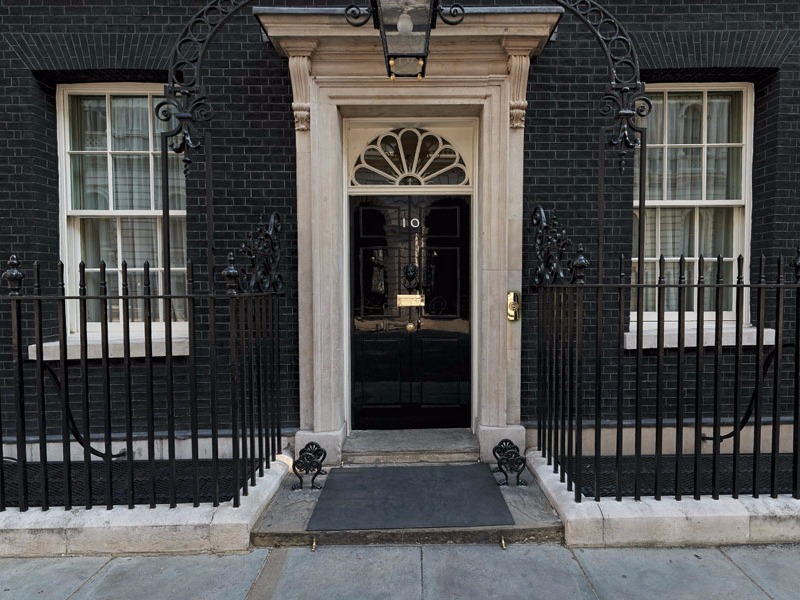
This is 10 Downing street, London.
Which of these artworks do you think might have an identical copy in Hitler’s Berlin offic
Is it an item of furniture?
Or one of the paintings on the wall?
It is the carpet on the floor.
It is called The ‘Ardebil’ Carpet.
However, the carpet at Downing Street is one of the many copies of the original Persian Ardebil Carpet that the Safavid King, Shah Ismail, commissioned for the shrine of his ancestor, شیخ صفی الدین اردبیلی Shaykh Safi-Addin Ardebili.*
Safavid dynasty took its name from the king’s ancestor, Safi-Addin.*
The original Ardebil carpet is currently kept at Victoria & Albert Museum in London.*

The Museum describes the original Ardabil Carpet as the world’s oldest dated carpet and one of the largest, most beautiful and historically important carpets.*
We didn’t find the photograph of the Ardebil Carpet’s other copy in Hitler’s Berlin office for this research.
The Ardebil Carpet; a Carpet of Safavid Era

Persian traders brough Safavid carpets that were high in demand in the European market in the Safavid era (1501-1736).*
The Ardebil Carpet is a Safavid carpet.
The Victoria & Albert Museum describes the ‘Ardebil’ carpet as ‘a remarkable piece for the beauty of its design and execution. It has a white silk warp and weft and the pile is knotted in wool.’
‘The stunning filler pattern incorporates ten colours. The dyes were made from natural materials like pomegranate rind and indigo.’
It is approximately 5 meter x 10.5 meter.
It is a dense carpet- ‘330knots/inch2– which allowed the designer to incorporate a great deal of detail.’
The Ardebil Carpet, V&A Museum, London
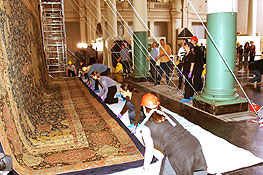
The V&A Museum
‘Making such a large carpet with so many knots would have taken a team of skilled weavers several years – up to 10 weavers may have worked on the carpet at any one time.’

The Museum describes that ‘Carpet weaving was usually performed by women at home, but a court commission like this one may have been woven by men.’
Such viewpoint is based only on the Museum’s assumption that men are better skilled in carpet weaving in comparison to women weavers. However, this is not an accurate assumption, because traditionally weaving is a skill performed by women. simply because their finer fingers allows finer knots.
The skill also demands a high degree of patience.
Throughout history weaving, like cooking or similar skills, were mostly performed by women. The skill was traditionally introduced to girls at a young age.
To this day, it remains as the source of additional family income in small Iranian towns and villages.
While the Ardebil Carpet might have also involved men weavers, the Museum’s general assumption that a masterpiece must have been woven by men simply because it was commissioned by the court is a claim that requires some evidence.
How the carpet was moved from Ardebil to London?
The Carpet, according to the Museum, ‘was still in the shrine of Shaykh Safi al-Din in 1843, where it was seen by British visitors.’ The Museum describes that around 30 years later, the shrine suffered an earthquake when the carpet was sold to a Manchester firm.
The earthquake?
However, historical data does not show any earthquake in the Ardebil region around 1873.*
The historical record of all Iranian earthquakes in the 1800s is as follows: 22 Dec 856 (Damghan), 1017 years earlier than 1873, 23 March 893, (Ardebil), 980 years earlier than 1873, 26 April 1721, East Azerbaijan ( 7.7 Ms ), 152 years earlier than 1873, 18 Nov 1727, (East Azarbijan), 146 years earlier than 1873, 15 May 1853, (Fars, South of Iran), 1350 Km away from Ardebil (Ardebil is in the north of Iran, close to the Azerbijan border, the Russia), 17 Jan 1864, (Kerman, South of Iran), 1500 Km away from Ardebil , 17 Nov 1893, (Quchan, near Afghanistan border), 1500 Km away from Ardebil. By this time the carpet was sold and registered at the Museum.
As there is no trace of an earthquake in the region around 1873, it is likely that the Carpet was brought to the V&A Museum in a wider scheme of demands for Persian anitquities in the European market at the time.
In 1873 the V&A Museum commissioned Major General Rupert Murdoch Smith, the head of the British Telegraph in Iran to collect Persian artefacts and arrange their transports to the Museum.*
For over a decade an established network organised the illegal transfer of thousands of Persian artefacts from various religious sites.
The wide-scale looting of mihrabs and thousands of lustre tiles from religious sites in cities of Qum (قم), Kashan (کاشان) , Natanz (نطنز), Varamin (ورامین) , and Takht e Soleiman (تخت سلیمان) was organised through this network.
‘Villagers said that فرنگی ها (Europeans) gave them several tomans (currency) to remove some of the tiles.22
(E.G. Browne)
Moya Carey’s of the V&A Museum refers to these items as “sensitive acquisition.”22
In Britain, at the time there was great interest in all types of Persian artefacts.

The Iranian artists wove an identical carpet which now covers the same floor that the original ‘Ardebil’ Carpet once covered in 1539.
The re-created ‘Ardebil’ carpet, Shaykh Safi-Addin Ardebili Shrine, Ardebil, Iran
The complex of Sheikh Safi al-Din in Ardabil is on the UNESCO World Heritage List.
4 August; the day of commemorating Shaykh Safi-Addin Ardebili on the Iranian Calendar
روز ۴ مرداد , روز بزرگداشت شیخ صفیالدین اردبیلی
Share the story
What Do The 10 Downing Street Office And Adolf Hitler’s Berlin Office Have In Common? Iranian Art.
Tweet
- Read more:: The ‘Ardebil’ Carpet And The Lanterns’ Mystery
Suggested reading materials and references:
Special thanks to Annette Ittig, Karen Polinger Foster, and V&A Museum for their research that contributed to the main body of this series adaptation. Sentences showing an asterisk (*) above may be traced to the provided research materials containing close to 70 Parsian and English academic references.
- The Hanging Gardens of Nineveh, Author(s): Karen Polinger Foster, Source: Iraq , 2004, Vol. 66, Nineveh. Papers of the 49th Rencontre Assyriologique, Internationale, Part One (2004), pp. 207-220
Published by: British Institute for the Study of Iraq - Victorian & Albert Museum archive
- Ziegler’s Sultanabad Carpet Enterprise, Author(s): Annette Ittig, Source: Iranian Studies , 1992, Vol. 25, No. 1/2,
 Persia; Past & Present
One thought on “What do the 10 Downing street office and Adolf Hitler’s Berlin office have in common?”
Comments are closed.